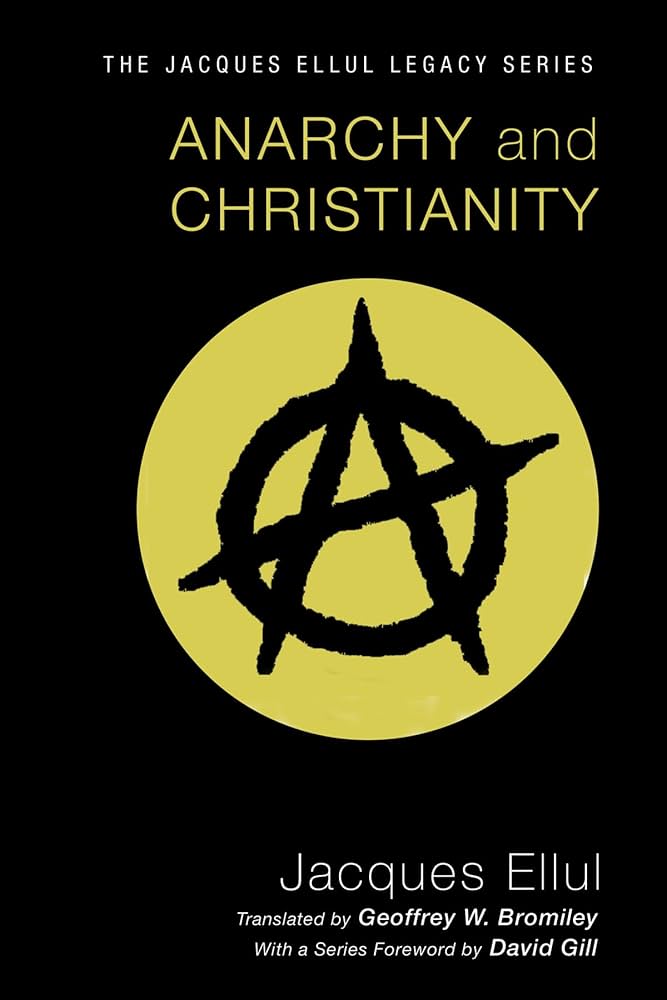
Christian Anarchism: An Introduction
In the first few centuries of the Roman Empire, being a Christian was the exception, not the rule. We find in the New Testament the derision and persecution the early Christians faced, many of them dying a martyr’s death. Today, in the American Empire, one solicits more shock and confusion in being an anarchist than a Christian. Of course, this is probably a good thing, as it means the West is amenable to Christianity (though hostile to whatever it thinks is anarchism). And yet, we wonder if a radical Christianity such as that practiced by the early church would meet with a stronger opposition today. Selflessness, detachment from material possessions, self-imposed ethics and laws, praying for one’s enemies, turning the other cheek… the list could go on. These are hard things to do and be, and yet we are called to them. Nevertheless, to announce to the world today that you are a Christian would probably not invite much surprise. What does invite surprise is to call oneself an anarchist. This is because to the extent that someone is familiar with that term, their first allusion is to bombs and street rioters in black clothing, something akin to rogue anti-fascist groups in the last few years. We wonder how Proudhon, Bakunin, or Emma Goldman would view these twenty-somethings who disrupt college speakers while filming it on their iPhone. No, this is not what anarchism is, or means.
There are a few ways to look at ideological and historical anarchism. As an idea and a concept, the term means “no authority.” It is not a positive program, but a negation on something specific: authority. Therefore it’s entirely possible that there have been scores of humans throughout history who might have identified as an anarchist, if the term were available for the taking. The French philosopher and sociologist, Jacques Ellul (1912-1994), argues that many of the first Christians were anarchists, or at least possessed an anarchist view toward political authority. He writes, “…the first Christian generation was globally hostile to political power and regarded it as bad no matter what its orientation or constitutional structures.” Historically, it was probably the French philosopher Pierre-Joseph Proudhon who intellectualized anarchism as a concept and movement in the nineteenth century. There were others, such as Mikhail Bakunin, Peter Kropotkin, Max Stirner, Johann Most, Benjamin Tucker, Emma Goldman, and Voltairine de Cleyre, to name only a few turn-of-the-century thinkers. One of my favorite anarchists to study is the American economist Murray Rothbard, who defended market anarchism, meaning a world regulated through voluntary exchange— think Ron Swanson when he says to privatize parks, and sell rides on the slide like tokens at Chuck E. Cheese. Each of these thinkers, including Jacques Ellul, whose book Anarchy and Christianity (1988) is the subject of this essay, had their own version of what a stateless society could look like, but they all agreed that political power could never be legitimate, whether monarchy, aristocracy, democracy, or anything in between. To be an anarchist meant and means that one denies the legitimacy of political power. Some of these anarchists opposed all types of power, hierarchy, and authority, including especially economic power, and some went so far as to deny parental authority over children. But at a minimum, these anarchists denied the moral legitimacy of political power, and as I see it this is what unites anarchists of various stripes. As a quick aside, they also rejected ill-gotten corporate power, variously known as crony capitalism or plutocracy. When business uses the State for privilege, it too must be rejected as immoral.
To return, in denying political power this does not mean pretending it doesn’t exist, but it denies the authenticity of that power. If someone were to steal you away and carry you out onto the ocean, you would deny the legitimacy of their power over you, while also recognizing that you are (currently) their captive. The goal, then, being to remove that power in both cases. I don’t have the space here to articulate what each of these thinkers proposed after the elimination of political power (but encourage you to read their books for yourself), but wanted to briefly digress to explain that for what historians and philosophers name “intellectual anarchists,” their goal was rarely the violent overthrow of political rule. To be sure, some of them did support violent movements and participate in violence themselves, but toward what they deemed to be the injustice of political power in the first place. Some Christian anarchists are pacifists, others are not, but to reconsider my analogy of being stolen away to the middle of the ocean, few would question the victim’s claim to use whatever means necessary to free themself. This is how anarchists see political power: an institution established over individuals against their will. Some of them argue that most means are justified in overthrowing that power, while others do not. But all recognize the illegitimacy of that power.
Jacques Ellul was a Christian anarchist and pacifist, and had a unique view on why violence—even in defense of a righteous goal—is impermissible. By violence we mean force, coercion, bloodshed, revolution, and war. I don’t imagine Ellul would argue that locking one’s doors at night, for instance, constitutes violence. But actual violence is out of bounds for Ellul’s framing of Christian anarchism. So to conclude this prologue, some anarchists have used violence in an effort to end political power, but Christian anarchism denies the use of force, and thus might be defined as: Christians who deny the legitimacy of political power but refuse to use violence against it. The “Christian” qualifier is significant because it does a few things: it means that this version of anarchism should not do anything Jesus wouldn’t do, and it orders one’s politics in a way that places Christianity above and before other commitments such as anarchism. This means that the Christian life is still totalizing: it suffuses faith in Christ into everything else. It is not “anarchist Christianity,” which might mean that ending political power is more important than one’s faith, but rather it means that one’s anarchism is filtered through one’s faith. It is not so different from being a “Christian Republican,” or “Christian Democrat,” in that it simply means a Chrisitian who espouses certain politics. Of course, the term Christian anarchist seems paradoxical, but it shouldn’t if one can rightly frame both Christianity and anarchism. If it could be shown that the two ideas contradict, then the term would make no sense, almost as if one were a “Christian atheist.” But properly understood, I agree with Ellul that anarchism is the most compatible political view of Christianity.
Does the Bible Rule Out Anarchism?
While I don’t think there’s one correct version of Christianity per se—meaning we all live as Christians in different ways—I do think it means a belief in the death and resurrection of Christ that bears itself out in radical ways. The radicality was why the early church was persecuted. As odd as it seems, I sometimes wonder if the way we practice Christianity today (myself included) is missing something since there is little persecution. If we live like Christ, and not like the world, shouldn’t the world hate us the way it did Christ and his followers? I don’t mean the fake outrage at things such as the Ten Commandments being placed in front of a public library (in fact I don’t think Christ would support taking people’s money to build religious monuments anyway), but perhaps the world would hate the way we earn or spend money, or the way we treat our neighbors, or the way we refuse to glorify the state and its graven images.
Christian anarchism aims at radical ends through peaceful, radical means. It continues to maintain that political power is illegitimate, but not because it supports atomistic individualism where we are all our own masters; it is not egoism. It denies political authority because Jesus himself opposed power, artificial hierarchy, and social oppression. Ellul makes a strong case that since Jesus refused to use violence and coercion, we should as well. And what is the State but violence and coercion? The State is generally inept at those activities we might want them to be good at, but extremely capable at those we do not, such as taxation and war. So it’s really good at taking people’s money, and killing people. That alone should be enough to convince that Christians should oppose the State, that we should be Christian anarchists. Thou Shalt Not Steal, Thou Shalt Not Murder. The State is the biggest violator of these two commandments in human history.
There are a few key passages in the Bible that most Christians would look to as affirming political power and the authority of what we now call the State. Indeed, in N.T. Wright and Michael Bird’s recent work, Jesus and the Powers (2024), they too find confirmation that God ordains earthly government toward his ultimate redeeming purpose. Granted, Wright and Bird are highly skeptical of how power has been used historically and is being used today, but nevertheless they make clear room for perpetual government until Christ’s return, ideally the liberal democracy most western nations now practice. Anarchy, they suppose, is off the table for Christians. Ellul disagrees, and I suggest Jesus disagrees. Before summarizing some of Ellul’s arguments, a few caveats are worth mentioning. There are passages and narratives in scripture that seem to affirm the legitimacy of governing authorities, whether Israel’s kings of old, or Paul’s admonition in Romans 13 to submit to governing authorities. Contextually, Ellul makes the case that these go-to passages are misinterpreted, of which I’ll return soon. My point is that it does make sense that most Christians would agree with the concept of having some form of government, pulling both from scripture and common sense. Without government, they might ask, who would administer justice, enforce laws, or punish wrongdoers? It would be, they might say, anarchy.
Point taken. In response, among other things, I would caution that the historical context of scripture is so particularly situated that it does not posit some ideal form of earthly government. In other words, we cannot use the Bible to say “the government in 2024 should look exactly like this,” any more than we can say the Bible is a blueprint for an ideal office space. The Bible is a series of books that collectively tell the story of God’s redeeming plan. It contains wisdom, encouragement, principles, and vision, among other things, but rarely if ever does it prescribe historically transcendent forms of earthly structures. For example, the Bible has several passages and principles for guiding marriage, but it doesn’t say who should take the trash out, who should put the kids to bed, or who should mow the lawn. Most things today look far different from the New Testament world of 2,000 years ago: marriage, parenting, the church, the economy, the nation, culture, etc. So we should be cautious in saying “But the Bible says this” as a cudgel for especially our politics. In the Bible, there is no American President, Supreme Court, or Bureau of Labor Statistics. To defend America’s political status quo is one thing, but to go from “The Bible says this, therefore Trump or Harris” is another. If Christian defenders of the current political system use the Bible’s principles as a means to evaluate the present, then so too can the State’s opponents. That is, so can Christian anarchists. Like most things, our vision for a better world is a combination of biblical wisdom, logic, empathy, and a commitment to human flourishing.
The Bible and Political Authority
What does the Bible say about political authority? At the very least, echoing Ellul, the Bible confirms that political power exists. But, by my reading, it does not suggest that it will or should always exist. If it will not exist in the new Jerusalem, and part of our task as Christians is to help build for the new kingdom, then might we propose that we work toward the elimination of it now? By way of comparison, if there will be no more sorrow, tears, and violence in the new heaven and new earth, it would make sense that we as Christians work toward a world right now that minimizes those things. Of course, we won’t do this completely, but we could certainly, in our own ways, attempt to erase violence from our lives. At the very least, we could choose not to be violent. With that in mind, we can also choose not to embrace the State, not to affirm it, not to participate in its machinations. In short, we can choose to ignore it as much as possible. I see nothing unbiblical about ignoring the State. In fact, as far as biblical justice goes, I see something very Christ-like in calling state actors to repentance for their violence and ill-gotten gains. Christian anarchism, then, is more of an ideal, a paradigm, and less a strategy. It is not a revolution, but a radical resignation. Ellul paraphrases Jesus’s message from Matthew 20: “…do not be so concerned about fighting kings. Let them be. Set up a marginal society which will not be interested in such things, in which there will be no power, authority, or hierarchy.”
Ellul contends that Christ’s attitude, while not de-social, was definitely de-political. We should note: it was not a-political, as if Jesus did not care about the political issues of his day, but it was de-political in the sense of removing the issue from politics. Hunger, poverty, violence and the like could be remedied through the global church, at least to the extent possible. This might remind us that if our biggest efforts to achieve justice come from the voting booth, something has gone wrong. Christian anarchism, then, gives us a sense of what the new heaven and earth could look like; it’s something to aspire to and work toward. Put most basically, if the Bible does not explicitly call for liberal democracy, a Republican Party, or a Democratic Party, then there is very little we can definitively say about the Bible’s stance on model earthly government. And if there is very little we can say about how we should be doing politics, then this does not rule out a system that aspires to peace and non-violence. So no, N.T. Wright and Michael Bird, the Bible does not rule out Christian anarchism.
As briefly as possible, what are Ellul’s reasons for Christian anarchism? The linchpin of his thought is that Christianity is a non-violent belief system. Christ is the Prince of Peace; we are called to be peacemakers; we are called to turn the other cheek; we’re reminded that those who take the sword will die by the sword; and we envision a time when the lion will lay down with the lamb. As Galatians says, “The whole law is fulfilled in one word: ‘You shall love your neighbor as yourself.’” But the State, as every philosopher readily acknowledges, is an institution that claims a special right to violence: the State alone claims the ability to jail, imprison, conscript, fight wars, administer the death penalty, and tax. These actions are not all inherently violent, but they are certainly backed by the threat of violence. What is more, every state gains control of a territory through violence, and claims to rule for everyone within its borders. The State is violent, but Christians are called to reject violence. With that in mind, how can Christians affirm an institution that is explicitly at odds with one of its central ethics? Christians may take the admittedly logical stance that the State, while violent, curbs unchecked further violence, such as criminals and invaders. But as Ellul says, “An authoritarian government can respond to violence only with violence.” When all you have is a hammer, everything looks like a nail. Even granting the shaky argument that the State stops what would be rampant violence and chaos among its citizens, this ignores the fact that the State is the largest purveyor of violence in history, with its wars, genocides, tanks, guns, and nuclear weapons. Is there no irony to the fact that the twentieth century—the century of nationalism—coincided with the bloodiest wars in human history? So we might have serious reservations about a Christian’s ability to love their neighbor while also empowering the State to tax their neighbor, confiscate their neighbor’s property, imprison their neighbor, and even send their neighbor to die in another war. Many of the first Christians went so far as to deny that believers could serve in the Roman army or government. So granting that today’s Christians desire peace, politics is not the way, and thus affirming the State is not the way.
Render Unto Caesar?
At heart, Ellul contends that politics is an unimaginative way to interact with our neighbors and confront the problem of injustice. It assumes that “doing something” means joining a political party, or voting. But, writes Ellul, “There remains the anarchism which acts by means of persuasion . . . [that aims at] a true overturning of authorities of all kinds as people at the bottom speak and organize themselves.” But voting—the most basic political act one can perform in a democracy—is not a form of peaceful persuasion. It is actually divisive as it makes us form teams and oppose one another. As Ellul notes, Satan—diabolos—means divider. And politics is one of the most divisive facets of our society. While voting may seem harmless enough, it is an affirmation of a violent system. Christian anarchism proposes simply to ignore the State by not participating. As more Christians choose not to participate, the mask of power slips. Power probably remains, as it always has, but Christians cannot be said to be complicit. Once we’ve thrown off the fetters of traditional politics, we’re free to organize in creative ways, undistracted by the make-believe justice the State promises. I’m reminded of this quote: “No matter what a politician promises, they always keep the bad ones and forget the good ones.” Even Trump, as I write this, is talking about “taking our country back” and how “Christians won’t need to vote again if we win this election” because everything will be fixed. Does he mean that things have somehow become catastrophically bad in the measly four years since he was the most powerful person in the world? Politics is a fool’s errand, and I find no implication in the Bible that we are called to participate in them.
But what of those passages that seem to affirm political power? If Christians can make a plausible case that the Bible does affirm political power, and that it’s part of God’s divine plan for redemption, then they would be correct to then argue we should participate where possible. Ellul has some thoughts. A prime example is the story from Mark where Jesus is asked whether or not it is lawful to pay taxes to Caesar. Firstly, it is not unimportant that those asking the question were trying to “trap” Jesus. If he says not to pay them, he is opposing Rome. If he says simply to pay them, he is perhaps defanging the radicality of his message: suggesting Christians can and should participate in Roman society and culture just as the Romans do. As always, Jesus gives an evasive answer, which I think is telling of Christ’s posture toward the State. Every time they put him to the test, he never gives the answer they want or expect. Might this suggest that Christians today can be creative in how they respond to cultural pressure or political expectations? Might it mean that there are always alternatives to the binary thinking of politics? At any rate, Ellul points out that Caesar’s image on the coin meant that he claimed all coinage with his inscription on it. In a very real way, then, Caesar owned all the money, regardless of who was holding it at that time. So when Jesus responds that we should “render unto Caesar that which is Caesar’s,” he is not commenting on the legality of taxation, or affirming the legitimacy of the Roman government. He is saying that since Caesar claims the money, give it back to him when he asks for it. But, as Ellul shows, Jesus is implicitly saying that though Caesar claims a limited domain—coinage and monuments, for example—he does not and cannot claim everything. “Whatever does not bear Caesar’s mark does not belong to him. It all belongs to God,” Ellul writes. And since Caesar’s claims are limited, “We may oppose most of his pretensions in the name of God.”
Now, does this mean we shouldn’t pay taxes? I don’t think it means that. We pay taxes because the state claims that this money is actually their money. We render unto the US government that which is the US government’s, and give it to them when they ask for it. We can do so begrudgingly—it doesn’t really matter—but doing so does not affirm their legitimacy, nor the claimed righteousness of their authority. By way of example, a thief stops you on the street and demands your wallet. Most of us know that there’s no good way out of that situation. We know that the money in our wallet is not really theirs, but they are claiming it should be. So we turn over our wallet; but who would suppose that doing so affirms their right to claim our money as their own? And so it is with taxes: we pay them because we’re in a no-win situation and if we didn’t pay them, they would take the money anyway. Christians might also be reminded of what the government does with that money which, among others, is build big bombs to drop on people far away who we’ve never met. But as Ellul reminds his readers, this transaction doesn’t have to stop here. Instead of voting in the “good guys” and voting out the bad ones—in an endless cycle of futility—Christian anarchists could call leaders to account for their sin, and we could try to help our neighbors in real ways, as well as the brothers and sisters in Christ across the world most afflicted by the ravages of the State. We can and should pray for political leaders, but pray that they would turn from their wickedness, not that they would reduce the tax rate by 3%. As Ellul contends, political power is ridiculous, in the literal meaning of that word: deserving derision. It is absurd in the same way that the naked emperor in the children’s story claims to be wearing clothes. As such, we might too develop a ridiculous posture toward it: we pay taxes, for example, because it is the minimal activity required to avoid confronting the State, and in doing so we are free to pursue things that really matter. As Ellul notes in the story of Jesus paying the temple tax, he “performs an absurd miracle”—pulling the tax from a fish’s mouth—“to show how unimportant power is.” If even a fish can pay taxes, what does this say about the legitimacy of the State? So to not cause offense, we do the bear minimum required by the State because they can have their ridiculous things—money and power and status—and we can pursue heaven on earth. Being a Christian anarchist means not being a political revolutionary. We are not seeking to overthrow the government. We pay taxes and generally “submit to the governing authorities” because this allows us the most space to love our neighbor. If by doing the political bare minimum, the State’s power diminishes, all the better. We point out that the emperor is wearing no clothes, but only to point people to Jesus as having real and redemptive power.
Political Addiction
Politics is like gambling, and Americans are addicted. They throw all of their chips into the middle of the table every four years, hoping that this is finally their hand. Perhaps they trust Trump when he says “everything will be fixed.” Perhaps Charlie Brown truly believes Lucy won’t pull the ball away this time. There is a difference in Christians working toward something and working through something. If our neighbor is a gambling addict, do we work through gambling in an effort to free him? Should we do the bad thing, too, so that good may come? By no means. There are certain activities and institutions that are so damaging that Christ tells us it’s better to lose an eye or an arm than to ruin the whole body. In this particular passage from Matthew 5, Jesus is referring to lust, not politics, but the message remains: flee from evil. Ironically, Christian anarchism is not telling people what to do, only what they shouldn’t do. They shouldn’t work through the evil means of the State even if done in effort to redeem or reconcile it. Christ can and will redeem all things; we cannot. Ellul concludes that we cannot erase political power, “But we can struggle against it. We can organize on the fringe. We can denounce not merely the abuses of power but power itself.” In paying taxes and generally obeying the government, we are, hopefully, free to organize on the fringe. As I see it, most of the problems politicos want solved through politics can be solved otherwise. Do you want people to be fed? Feed them. Do you want kids to be educated? Educate them. Do you want care for single mothers? Provide it. The truly unimaginative solution to so-called political issues is politics.
Political problems? Maybe.
Political solutions? Never.

 kollinfields.com